
The Static Link Flaw: The Security Gap in Your Sales Team's Smart Business Cards

 7 minutes read
The Static Link Flaw: The Security Gap in Your Sales Team’s Smart Business Cards
The unseen enterprise vector
Corporate IT spends heavily to lock down laptops, mailboxes and networks. Then the sales team walks into a conference with an unmanaged data endpoint in every pocket: the smart business card.
Most smart business cards were designed for convenience. A tap opens a web page showing a name, mobile number, corporate email and job title. The question that rarely gets asked is what else can reach that page, and for how long.
This post makes one narrow, technical argument. On a conventional smart business card, a tap opens the employee’s permanent profile address in the recipient’s browser and leaves it there. That design choice, which we call the Static Link Flaw, turns each employee’s contact record into a standing web endpoint. Across a whole sales team, it exposes a slice of the corporate directory to anyone who collects the links.
PIXEL builds smart business cards in Riyadh for teams across Saudi Arabia and the GCC. PIXEL cards are designed around this flaw with Dual-Layer NFC Architecture: the link left in a recipient’s browser after a tap has already expired. The sections below explain the flaw, the architecture, and what happens in the seconds after a tap.
The mechanical flaw of the static link
A conventional smart business card is a simple device. Its NFC chip points straight at a public profile page. Every tap opens that page, at the same address, in the recipient’s browser.
The Static Link Flaw is the security weakness this creates: every recipient’s browser receives and keeps the permanent, public address of the holder’s profile, and that address never expires.
The tap itself is not the problem. NFC works over a few centimetres, and the person tapping is someone the employee chose to meet. The problem is what the tap leaves behind:
- A reusable address. The URL stays in the recipient’s browser history and synced tabs. It works again tomorrow, next year, and on any other device.
- A forwardable address. Pasted into a chat or an email, the link gives a third party the same access as the original recipient.
- A scrapable address. A public profile page typically answers automated requests as readily as human ones. Where profile URLs follow a readable pattern, such as a name or a sequence, a script can collect a team’s profiles in bulk.
- A live window. The page shows current data. When an executive updates a number or a job title, everyone who ever held the link sees the update.
The exposure lasts as long as the profile stays online. For one person, that is a privacy issue. For a sales organisation, it is a harvestable map of names, titles, direct lines and corporate email formats, which is the raw material for spear phishing and business email compromise.
Dual-Layer NFC Architecture
Dual-Layer NFC Architecture is PIXEL’s design for separating what the card transmits from where the profile lives. The permanent profile record and the physical NFC transmission are two independent layers, joined only for the duration of a tap.
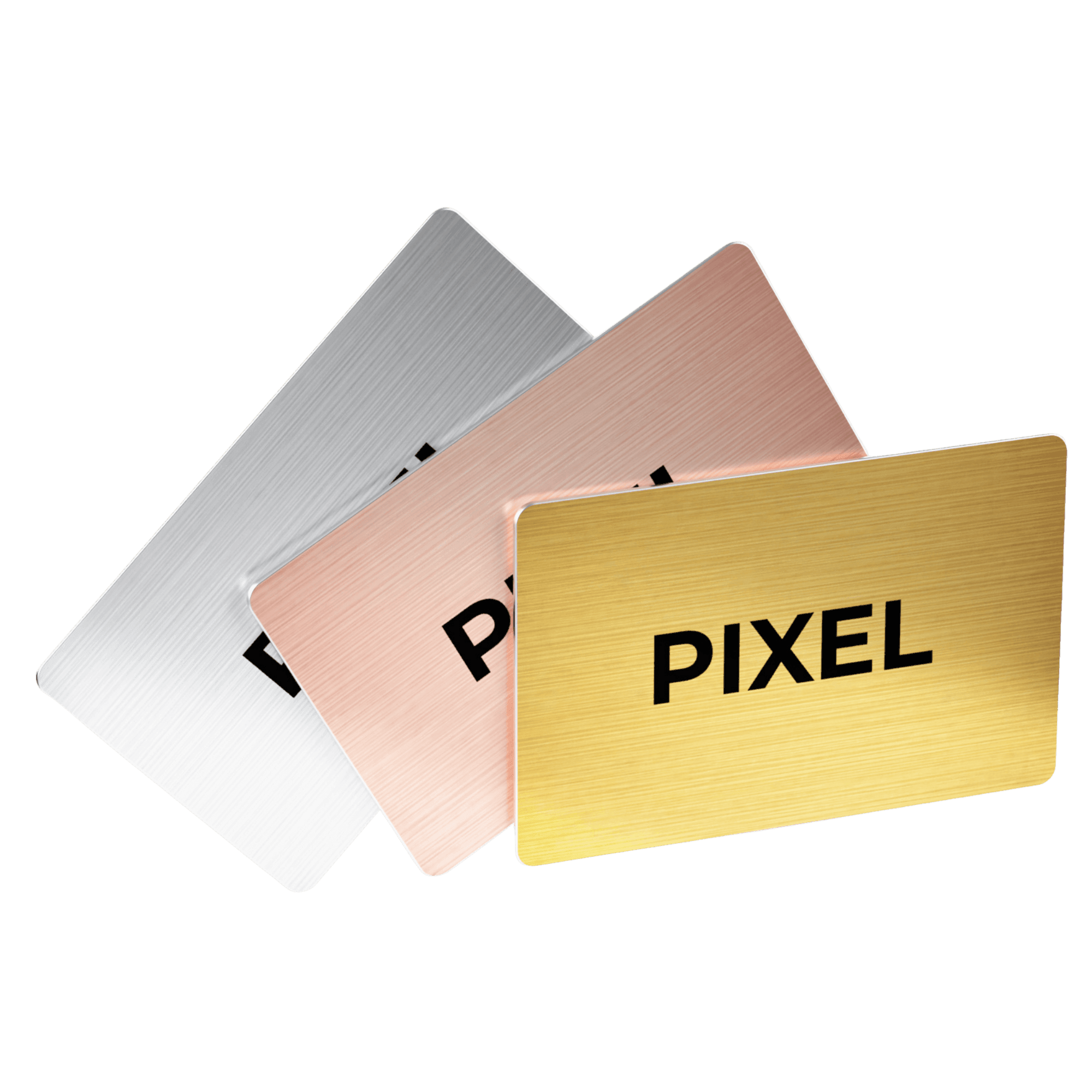
PIXEL treats a smart business card as the trigger for an exchange, not as the address of the data. Whether the card is PVC or metal, its job is to start that exchange. It carries no contact data.
| Layer | Component | Role |
|---|---|---|
| Transmission layer | The card and its NFC chip | Starts the exchange. Carries no contact data. |
| Profile layer | The PIXEL platform, hosted inside Saudi Arabia | Stores the contact record and company settings. Releases a contact only against a valid token. |
Decoupling the two layers changes what an attacker can collect:
- Nothing reusable in the browser. The address a recipient’s browser keeps has expired, so there is nothing in the history to reopen or forward.
- Revocation at the card. A company admin can deactivate a lost or stolen card from the dashboard, so the card stops releasing the employee’s details.
- Central policy. Role-based admin access lets the company set each card’s mode. By default, employees cannot edit their own corporate details.
The card becomes a controlled way to request a contact, and the company decides whether that request is honoured.
Inside a PIXEL tap: self-destructing Single-Use Tokens
A PIXEL tap is a four-step exchange that ends with nothing reusable left in the recipient’s browser.
- The tap opens an encrypted session. The recipient’s phone reads the card and opens an encrypted session with the PIXEL platform. The platform checks that the card is active and has not been deactivated.
- The platform issues a Single-Use Token. PIXEL generates a unique token URL for this tap only. No earlier tap produced it, and no later tap will reuse it.
- The phone loads the profile payload. The token is redeemed once, and the platform returns the contact record to the recipient’s phone.
- The token self-destructs. Redemption invalidates the token. The address the phone just used no longer resolves to anything.
The security property is simple to state. A Single-Use Token is valid for one tap and one redemption, so it cannot be replayed.
Consider the collection paths opened by the Static Link Flaw. A bad actor who extracts the URL from a mobile browser history finds a dead, inactive link. A recipient who forwards the link forwards nothing. A link harvested from a chat, a screenshot or a synced tab is just as dead.
The same principle covers the QR code in PIXEL Connect. It stands in for the physical card when the card is not to hand, and it is deliberately non-permanent, so it cannot become a static link by another route.
Eliminating the landing page attack vector
A conventional smart business card sends the recipient to a public landing page first. The contact is one button among several: social links, a lead form, banners, sometimes third-party scripts.
That intermediate page is extra attack surface, and it sits between the tap and the contact:
- It is a public web asset. The page can be requested, monitored and copied by anyone holding the address.
- It can be imitated. A cloned profile page with a changed phone number or a credential form is a ready-made phishing lure, because recipients already expect to land on a web page.
- It can observe the visitor. Analytics and embedded scripts on a profile page see the recipient’s device, location hints and visit time.
PIXEL’s Instant Save mode removes the page from the route. The tap resolves straight to the smartphone’s native contact interface, where the recipient saves the contact. There is no public profile page to browse, clone or scrape, and the only trace in the browser history is a spent token.
Teams that want two-way contact exchange can switch on Digital Profile through PIXEL Connect. That is a deliberate, admin-controlled choice. A company can lock every card to Instant Save by default.
Structural comparison
| Criterion | Conventional smart business cards (static-link model) | PIXEL smart business cards |
|---|---|---|
| Link a tap opens | The permanent profile URL itself | Single-Use Token generated per tap |
| Link found later in browser history | Still opens the live profile | Dead, inactive link |
| Data scraping risk | Public profile page at a stable address, open to automated collection | Links left in browsers have expired; Instant Save has no public profile page |
| Network route | Tap, browser, public landing page, then the contact | Tap, token, then the phone’s native contact interface |
| Lost or stolen card | Depends on the provider; the printed link keeps resolving until the profile is taken down | Company admin deactivates the card from the dashboard |
| Admin control | Varies by provider | Role-based dashboard; card mode set by the company |
| Data residency | Varies by provider | Hosted inside Saudi Arabia; PDPL compliant |
| Ordering process | Usually a flat design proof | Interactive 3D Viewer, built by PIXEL, to inspect the card before ordering |
The middle column describes the static-link model as a category. Individual providers differ in implementation, so put the same questions to any vendor on your shortlist.
The new standard for corporate networking
Physical networking is part of the corporate attack surface. It should meet the same security and compliance bar as email and endpoints. A card that leaves a permanent, live link to an employee’s details in every recipient’s browser does not meet that bar.
Three questions settle whether a smart business card belongs in an enterprise:
- Does a tap leave the permanent profile address in the recipient’s browser?
- Does a link copied from browser history still work a week later?
- Can an admin deactivate a lost card centrally?
With PIXEL’s Dual-Layer NFC Architecture, the answers are no, no and yes. The card starts the exchange, a Single-Use Token completes it, and nothing reusable stays behind in the browser.
PIXEL is a Saudi-owned company based in Riyadh. The platform is hosted inside Saudi Arabia and is PDPL compliant, and PIXEL exhibited at LEAP 2026.
If you run IT procurement, put the three questions to your current card provider. If you lead a revenue team, ask what your reps’ cards leave behind after every meeting. Then contact PIXEL to move your team to smart business cards that protect its data.


