
Best CRM for Small Business in Saudi Arabia: 2026 Guide

What should a Saudi small business look for in a CRM?
Choosing the best CRM for a small business in Saudi Arabia is less about the longest feature list and more about fit. A CRM (customer relationship management system) is where your team keeps every client, deal and follow-up in one place, instead of in phones, notebooks and WhatsApp chats. For a Saudi team of 2 to 20 people, we recommend checking six things before anything else:
- A free or low-cost start. Several big CRMs have free plans for very small teams, so you can test before you pay.
- Arabic. If some of your team or clients work in Arabic, check the interface language and that Arabic names and RTL text display correctly.
- Where your data is stored. Client names and numbers are personal data under Saudi Arabia’s Personal Data Protection Law (PDPL), which has rules on sending personal data outside the Kingdom (DLA Piper, Feb 2026).
- How contacts get in. A CRM is only as good as the contacts your team actually enters. Look at import, mobile apps, email and WhatsApp, and how contacts from face-to-face meetings get in.
- Integrations with the tools you already use: email, calendar, accounting, your website forms.
- Ease of use for the sales reps, not just the manager. If reps find it slow, they won’t use it.
Short answer
For most small businesses in Saudi Arabia, Zoho CRM and HubSpot are the easiest places to start: both have free plans (Zoho for 3 users, HubSpot for 2). Zoho also says its suite is hosted in Saudi Arabia. Salesforce and Microsoft Dynamics 365 suit growing teams with bigger budgets and complex processes.
Disclosure: this guide is published by PIXEL, a Riyadh company that makes smart business cards. PIXEL is not a CRM and has no commercial relationship with the vendors below. PIXEL Connect syncs leads to some of them, which is explained in its own section.
Which CRMs do Saudi small businesses compare most?
The same names come up again and again in Saudi CRM guides: Zoho CRM, HubSpot, Salesforce and Microsoft Dynamics 365, plus local all-in-one platforms such as Daftra that bundle a CRM with invoicing and accounting (Daftra, Oct 2025; SoftwareSuggest Saudi Arabia list). Here is how the four global options compare on what matters most to a small Saudi team, as checked on 15 November 2026:
| CRM | Free option | Arabic interface | Hosting in Saudi Arabia | Best fit |
|---|---|---|---|---|
| Zoho CRM | Free edition for up to 3 users | Yes (Arabic is one of 28 languages) | Zoho says its suite, including CRM, is hosted in the Kingdom; data centres in Riyadh and Jeddah opened in March 2024 | Small teams that want low cost, Arabic and local hosting |
| HubSpot | Free CRM for up to 2 users | Check with HubSpot | Not stated on the pages we checked: ask HubSpot where your data is stored | Teams that also run email marketing and website forms |
| Salesforce | Paid plans (see the vendor’s pricing page) | Check with Salesforce | Announced in February 2025 that it will bring its Hyperforce platform to Saudi Arabia on AWS; no go-live date in the announcement | Growing teams with complex sales processes and budget for setup |
| Microsoft Dynamics 365 Sales | Paid plans (see the vendor’s pricing page) | Check with Microsoft | Microsoft’s Saudi Arabia East cloud region was announced for Q4 2026 (reported as November 2026); the announcement doesn’t say which apps run there | Companies already on Microsoft 365 and Outlook |
Prices and plans change often. HubSpot’s paid Starter plan was shown from USD 7 per seat per month (new-customer discount, tax extra) on its pricing page on 15 November 2026. Zoho shows prices per user per month with VAT charged on top. Always check the vendor’s own pricing page in SAR before you decide.
What about local platforms? Saudi all-in-one tools combine a simple CRM with quotes, invoices and accounting. They can be a good fit if you want one system for sales and finance. If the tool issues your tax invoices, we recommend asking the vendor to confirm it meets ZATCA’s e-invoicing (Fatoora) requirements for your business.
Does your CRM need to store data in Saudi Arabia?
Not always, but it’s a question to ask. The PDPL came into effect on 14 September 2023, with compliance generally due by 14 September 2024, and it is enforced by SDAIA (DLA Piper, Feb 2026). It allows personal data to be transferred outside the Kingdom for several purposes, under conditions: the transfer must not harm national security or the Kingdom’s vital interests, it should be limited to the minimum data needed, and it goes either to countries with an adequate level of protection or with appropriate safeguards. Some sectors, such as banking, have their own extra rules (DLA Piper, Feb 2026).
In practice, for a small business:
- If you sell to government entities or work in a regulated sector, we recommend choosing a CRM that can host your data in Saudi Arabia, and checking with your regulator or legal adviser.
- If you’re a small private company, a CRM hosted abroad can still be used, but ask the vendor how it handles PDPL transfers, and collect only the client data you need.
This is general information, not legal advice.
How much does a CRM cost a small team?
You can start for free. Zoho CRM’s free edition covers up to 3 users and HubSpot’s free CRM up to 2 users (vendor pricing pages, 15 November 2026). That is enough for a founder and one or two salespeople to build the habit.
When you outgrow the free plan, CRM pricing is almost always per user, per month, often cheaper when paid yearly, with VAT on top in Saudi Arabia. So the real question is how many people need a paid seat. We recommend paying only for the people who manage clients and deals, and keeping everyone else on free or read-only access where the CRM allows it.
How to choose a CRM in 6 steps
- Write down your sales process in 4 to 6 stages (for example: new lead → meeting → quote → negotiation → won/lost). The CRM should fit your process, not the other way round.
- Shortlist two CRMs from the table above, based on budget, Arabic and data hosting.
- Trial both with two real salespeople for two weeks, using real clients. Ask them which one they’d actually open every day.
- Import your existing contacts (phone contacts, Excel sheets, old business cards) and check that Arabic names and +966 numbers come through correctly.
- Connect the tools you use daily: email, calendar, website forms, and whatever your team uses to meet clients in person.
- Set one simple rule for the team, such as “every client meeting is in the CRM the same day”, and review it weekly. Our guide on how to get your sales team to use the CRM in Saudi Arabia covers adoption in detail.
Why do small teams stop using their CRM?
In our experience, the most common reason isn’t the software: it’s data entry. Salespeople meet clients at offices, events and exhibitions, then have to type every name, number and company into the CRM later. When that step is slow, the CRM fills up with gaps and the manager stops trusting it.
That’s why the way contacts enter the CRM matters as much as the CRM you choose. Options include:
- importing contacts in bulk from Excel or the phone,
- scanning paper business cards with an app (see how to scan business cards into your CRM),
- website and WhatsApp forms that create contacts automatically,
- capturing the client’s details at the moment you meet them, with a lead capture tool that syncs to the CRM.
Once the contact is in, the follow-up still has to happen. Our guide on how to follow up after a sales meeting in Saudi Arabia has templates for email and WhatsApp.
Where PIXEL fits
PIXEL doesn’t replace your CRM. It fixes the step before it: getting the details of the people your team meets face to face into the CRM, without typing.
- PIXEL smart business card with Instant Save: each team member taps their card on a client’s iPhone or Android phone and their details save straight to the client’s contacts. No app on either side, no subscription needed for this. Learn how a smart business card works.
- PIXEL Connect, for the people who collect leads (optional subscription): the card opens a Digital Profile that invites the client to share their details back, and they’re saved as a lead. Connect also scans paper business cards with AI and offers an in-app QR for the day you forget your card. The card itself has no printed QR: it works by tap.
- CRM sync: leads your team collects with PIXEL Connect go to HubSpot, Salesforce or Dynamics 365 (pixel-nfc.com features page), attributed to the person who met the client. Team members who only share their details stay on Instant Save and don’t need Connect.
- One dashboard for the team: views, leads and each employee’s card, with details edited centrally.
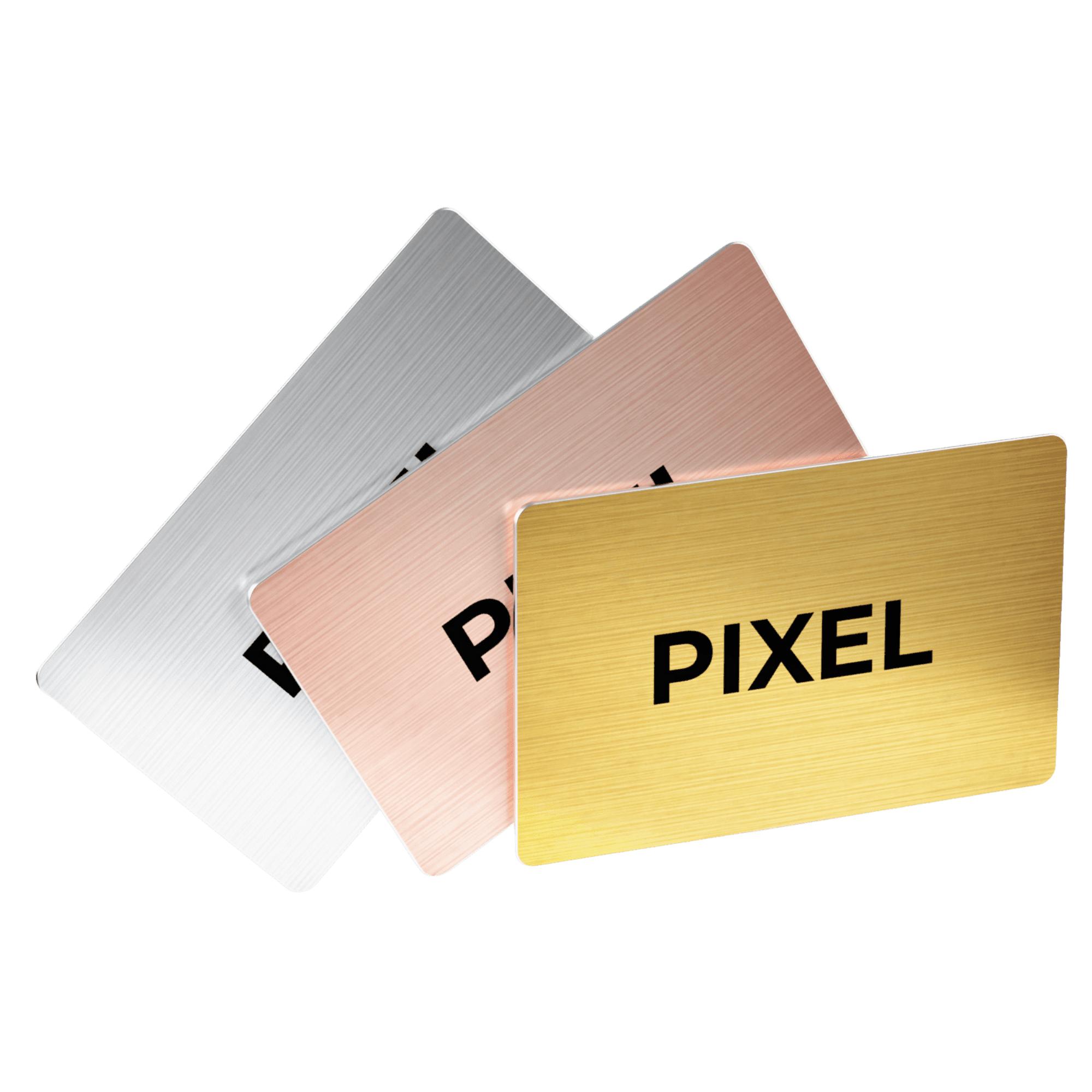
PIXEL Original costs SAR 125 per card and PIXEL Metal Edition SAR 235 per card, as a one-time purchase (pixel-nfc.com shop, checked 15 November 2026). Connect starts at SAR 25 per user for 3 months. Read more about PIXEL smart business cards for companies in Saudi Arabia.
FAQ
What is the best free CRM for a small business in Saudi Arabia?
Zoho CRM and HubSpot both have free plans: Zoho for up to 3 users and HubSpot for up to 2 (checked 15 November 2026). Zoho also offers an Arabic interface and says its suite is hosted in Saudi Arabia.
Is there a CRM with an Arabic interface?
Yes. Zoho CRM lists Arabic among its 28 supported languages. For other CRMs, check the vendor’s language settings and test Arabic names and right-to-left text during your trial.
Which CRMs host data in Saudi Arabia?
Zoho says its suite, including CRM, is hosted in Saudi Arabia, with data centres in Riyadh and Jeddah since March 2024. Salesforce and Microsoft have announced Saudi hosting plans; ask each vendor which apps are available locally today.
Does the PDPL forbid using a CRM hosted outside Saudi Arabia?
Not outright. The PDPL allows transfers outside the Kingdom under conditions such as adequate protection or appropriate safeguards, with extra rules in some sectors. Check with the vendor and, for regulated sectors, a legal adviser.
How much does a CRM cost per user?
Paid plans are usually priced per user per month, with VAT on top in Saudi Arabia. HubSpot’s Starter was shown from USD 7 per seat per month on 15 November 2026; check each vendor’s pricing page for current SAR prices.
Do I need a CRM if I only have 2 or 3 salespeople?
We recommend it once you lose track of follow-ups or clients. A free plan is enough to start, and it builds the habit before the team grows.
How do I get contacts from meetings and events into my CRM?
Import existing contacts, scan paper cards, and capture new contacts as you meet them. A PIXEL smart business card with PIXEL Connect saves the client’s details as a lead and syncs it to HubSpot, Salesforce or Dynamics 365.
Is PIXEL a CRM?
No. PIXEL makes smart business cards. PIXEL Connect collects leads from face-to-face meetings and sends them to your CRM.
The verdict
For a small business in Saudi Arabia, start simple: pick a CRM with a free plan, test it with your real team, and check Arabic and data hosting before you commit. In our view, Zoho CRM is the strongest all-round fit for very small Saudi teams on cost, Arabic and local hosting; HubSpot is a strong free start if marketing matters to you; Salesforce and Dynamics 365 make sense as you grow. Whatever you choose, make sure the contacts your team meets in person actually reach it.
Want leads from every meeting in your CRM? Get a team quote → pixel-nfc.com/en/shop?tab=teams or book a demo → pixel-nfc.com/en/contact Just for you? Order your PIXEL card → pixel-nfc.com/en/shop
If your team still prints business cards, we can help.
Sources
All checked on 15 November 2026; they may have changed since.
- Zoho, “Business Software Hosted in Saudi Arabia” (suite incl. CRM hosted in the Kingdom; CST Class-B certified), no date on page. https://www.zoho.com/en-sa/hosted-in-saudi-arabia.html
- Zoho Corp. / ManageEngine, “Zoho Corp. Announces the Opening of its First Middle East Data Centres in Saudi Arabia”, 4 March 2024 (Jeddah and Riyadh). https://www.manageengine.com/news/zohocorp_opening_first_middle_east_data_centres_saudi_arabia.html
- Zoho, “Zoho CRM Pricing and Editions” (free edition for 3 users; 28 languages incl. Arabic; local taxes extra). https://www.zoho.com/crm/zohocrm-pricing.html
- HubSpot, CRM pricing page (free for up to 2 users; Starter from USD 7/mo/seat, new-customer discount, tax extra). https://www.hubspot.com/pricing/crm
- Salesforce, “Salesforce Announces $500M Investment in Saudi Arabia to Drive AI Innovation and Growth”, 10 February 2025 (Hyperforce to Saudi Arabia via AWS). https://www.salesforce.com/news/press-releases/2025/02/10/saudi-arabia-investment/
- Microsoft, “Microsoft Confirms Saudi Arabia Datacenter Region Available for Customers to Run Cloud Workloads from Q4 2026”, 10 February 2026. https://news.microsoft.com/source/emea/2026/02/microsoft-confirms-saudi-arabia-datacenter-region-available-for-customers-to-run-cloud-workloads-from-q4-2026/
- Deborah Grey, “Microsoft’s Saudi Arabia East data center region to be available in November 2026”, W.Media, 3 September 2026 (citing a Microsoft press release). https://w.media/microsofts-saudi-arabia-east-data-center-region-to-be-available-in-november-2026/
- DLA Piper, “Data Protection Laws of the World: Saudi Arabia – Transfer”, last modified 11 February 2026. https://www.dlapiperdataprotection.com/index.html?t=transfer&c=SA
- Alaa Jamal, “Best CRM Software in Saudi Arabia”, Daftra, 7 October 2025 (vendor guide; lists Daftra, Zoho, Salesforce, HubSpot, Zendesk). https://www.daftra.com/en/hub/best-crm-software
- SoftwareSuggest, “Best CRM Software in Saudi Arabia” (directory listing). https://www.softwaresuggest.com/crm-software/sa
- PIXEL product details and prices: pixel-nfc.com (features and shop pages), checked 15 November 2026.
Table of contents
- What should a Saudi small business look for in a CRM?
- Short answer
- Which CRMs do Saudi small businesses compare most?
- Does your CRM need to store data in Saudi Arabia?
- How much does a CRM cost a small team?
- How to choose a CRM in 6 steps
- Why do small teams stop using their CRM?
- Where PIXEL fits
- FAQ
- What is the best free CRM for a small business in Saudi Arabia?
- Is there a CRM with an Arabic interface?
- Which CRMs host data in Saudi Arabia?
- Does the PDPL forbid using a CRM hosted outside Saudi Arabia?
- How much does a CRM cost per user?
- Do I need a CRM if I only have 2 or 3 salespeople?
- How do I get contacts from meetings and events into my CRM?
- Is PIXEL a CRM?
- The verdict
- Sources
One Smart Business Card replaces thousands of paper cards.
Better for your wallet, better for the planet.


One-time purchase · Upgrade to PIXEL Connect anytime


