
Business Card Etiquette in Saudi Arabia: 9 Practical Rules

Do business cards still matter in Saudi Arabia?
Yes, but the sources differ on how much. Visa specialist CIBTvisas calls business cards “very important in Saudi Arabian business culture”, while the Cultural Atlas (2019) says they “may be exchanged, but are not essential”. What every guide agrees on is the bigger picture: Saudi business runs on personal relationships, and people prefer to work with those they know (Cultural Atlas; Expatica, 2025).
So the card itself isn’t the deal. It’s a small, early moment where you show respect and make it easy for someone to remember and reach you. Getting that moment right is what the rules below are about.
Short answer
Business card etiquette in Saudi Arabia comes down to respect: give and receive cards with your right hand, offer an Arabic side if you can, read the card before putting it away, and use the titles printed on it. With a smart business card, ask before tapping and let the other person save your details on their own phone.
9 rules for exchanging business cards in Saudi Arabia
1. Greet first, then exchange cards
Handshakes come before cards. Expatica (updated April 2025) advises greeting everyone in the room, starting with the most senior person, and exchanging cards at the start of the meeting. When greeting a woman, wait for her to extend her hand first; if she doesn’t, keep your hand by your side (Expatica; World Health Expo, 2023).
2. Use your right hand to give and receive
The Cultural Atlas, Expatica and CIBTvisas all say to pass and receive business cards with the right hand. It’s the simplest rule on this list and the one people notice most.
3. Offer an Arabic side
Expat.com’s Riyadh guide recommends having one side of your card translated into Arabic and checking the translation carefully, especially the order of Western names. CIBTvisas gives the same advice. In our experience, a correctly written Arabic name and title is noticed and appreciated, even by counterparts who work in English every day.
4. Hand it over Arabic side up
CIBTvisas recommends presenting the card so that the Arabic side faces the person receiving it. It’s a small gesture that shows you prepared for this meeting, not just any meeting.
5. Look at the card before you put it away
CIBTvisas advises placing a card you receive on the table during the meeting rather than putting it straight into your pocket. We recommend reading it properly when you receive it: the name, the title, the company. It helps you remember the person and use the right form of address.
6. Use the titles printed on the card
Titles matter. The Cultural Atlas says professional titles such as “Doctor” or “Ustadh” are used, followed by the person’s first name. Expatica suggests noting designations on the card (such as Shaikh, Doctor or Engineer) and using them from time to time in conversation.
7. Keep your own card simple
CIBTvisas recommends sticking to essential information: your name, contact details and position. We’d add: make sure your title is accurate and current. An out-of-date job title on a card sets an awkward tone.
8. Don’t rush from card to pitch
The first meetings are often about getting to know each other, with tea, coffee and small talk before business (Cultural Atlas; CIBTvisas; Expatica). Decisions can take time (Cultural Atlas; World Health Expo). Swapping cards is the start of a relationship, so don’t treat it as the moment to push for a decision.
9. Follow up at the right time
The standard working week in Saudi Arabia runs Sunday to Thursday, with Friday and Saturday as the weekend (Cultural Atlas; World Health Expo; Expatica). Meetings are also scheduled around daily prayers (Cultural Atlas). We recommend sending your follow-up on a working day, referring to something specific you discussed, and asking which channel they prefer.
Business card etiquette at a glance
| Do | Avoid |
|---|---|
| Greet first, most senior person first | Handing out cards before greeting anyone |
| Give and receive with the right hand | Passing cards with the left hand |
| Offer an Arabic side, checked carefully | A machine translation nobody has proofread |
| Read the card and keep it on the table | Pocketing it without a glance |
| Use the title on the card (Doctor, Engineer…) | Dropping titles too early |
| Follow up Sunday to Thursday | Expecting replies on Friday or Saturday |
Based on the guides listed in Sources (checked 7 November 2026). Customs vary between people, sectors and regions; when in doubt, follow your host’s lead.
How to exchange a smart business card politely
If you share your details with a smart business card (a card with an NFC chip that sends your contact details to the other person’s phone when they tap it), the same courtesy rules apply, plus a few of its own. Our recommendations:
- Ask first. “May I send you my details?” is better than reaching for someone’s phone.
- Let them hold their own phone. Hold your card near their phone; never take their phone from them.
- Use your right hand to offer the card, exactly as you would a paper card.
- Check it worked. Wait a second for the contact to appear on their screen, then let them save it.
- Still read their card. If they hand you a paper card, give it the same attention as in rule 5 above.
- Keep a few paper cards if you often meet people who prefer them. Etiquette is about making it easy for the other person, not about the format.
If you’re new to the category, our guide what a smart business card is and how it works explains the basics, and whether smart business cards save contacts automatically covers what the other person actually sees.
Where PIXEL fits
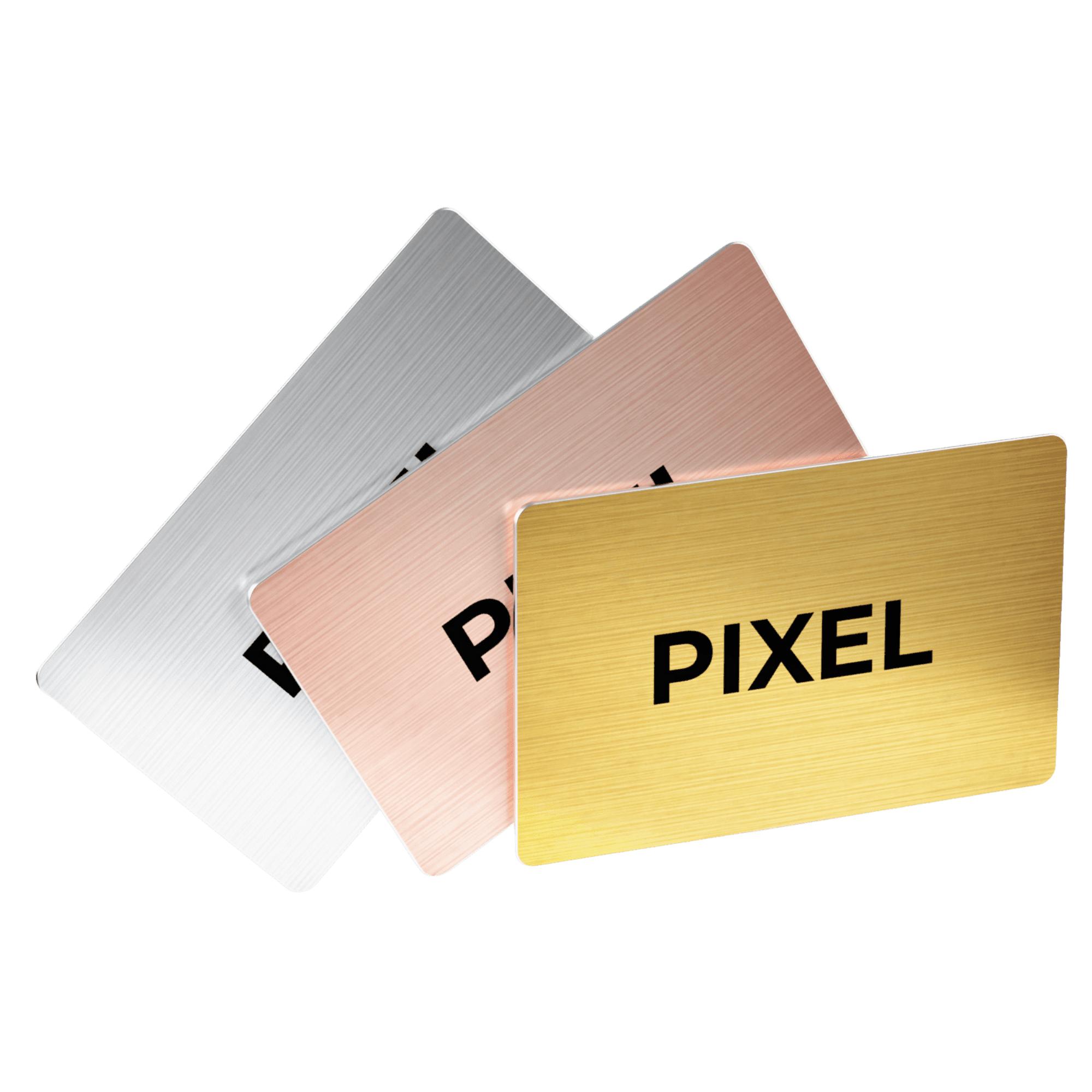
A PIXEL smart business card is designed to make this moment quick and polite:
- Instant Save: one tap and your contact downloads straight to the other person’s phone. No app is needed on either side, and Instant Save is free.
- Your own artwork: you can upload your own design, so one side of the card can carry your name and title in Arabic, checked by you before anything is printed. See how to get a custom smart business card with your logo made in Saudi Arabia.
- Always up to date: your details stay editable, so a new title or number never means a reprint.
- Tap only: PIXEL cards carry no printed QR code. If you have the optional PIXEL Connect subscription, the PIXEL app also has an in-app QR for the times you forget your card.
- For people who collect leads: with Connect, the other person can share their details back from your Digital Profile, so both of you leave with each other’s contact. Companies use this for sales and business development teams; see PIXEL smart business cards for companies in Saudi Arabia.
PIXEL cards are made and encoded in Riyadh. For a side-by-side view of the options, see the best smart business cards in 2026.
FAQ
Which hand should I use to give a business card in Saudi Arabia?
Use your right hand to give and to receive business cards. The Cultural Atlas, Expatica and CIBTvisas all recommend it.
Should my business card be in Arabic?
It’s recommended. Guides such as Expat.com and CIBTvisas suggest one side in Arabic, with the translation checked carefully, especially the order of names.
When do you exchange business cards in a Saudi meeting?
Usually at the start of the meeting, after the greetings (Expatica). Greet the most senior person first.
Is it rude to put a business card away immediately?
It can look careless. CIBTvisas recommends keeping the card on the table during the meeting, and we recommend reading it before you put it away.
Should I shake hands with a woman in a Saudi business meeting?
Wait for her to extend her hand first. If she doesn’t, keep your hand by your side (Expatica; World Health Expo).
What days are best for a follow-up in Saudi Arabia?
The working week runs Sunday to Thursday, with Friday and Saturday as the weekend, so follow up on a working day.
Is it polite to use a smart business card in a Saudi meeting?
Yes, if you use it courteously: ask first, use your right hand, and let the other person save your details on their own phone.
Does the other person need an app to receive a PIXEL card?
No. With Instant Save, the contact downloads straight to their phone with no app on either side.
The verdict
Good business card etiquette in Saudi Arabia is mostly about attention and respect: the right hand, an Arabic side, a real look at the card, the right title and a well-timed follow-up. A smart business card doesn’t change those rules; it just makes the exchange faster and keeps your details current.
Order a PIXEL card → pixel-nfc.com/en/shop Equipping a team? Get a team quote → pixel-nfc.com/en/shop?tab=teams
If your team still prints business cards, we can help.
Sources
All checked on 7 November 2026; they may have changed since. Customs guides describe general practice and may not reflect every person or sector.
- Nina Evason, “Saudi Arabian Culture: Business Culture”, Cultural Atlas (Mosaica), 2019. https://theculturalatlas.org/saudi-arabian-culture/saudi-arabian-culture-business-culture
- Mark Lazell, “Work culture and business etiquette in Saudi Arabia”, Expatica, last updated 17 April 2025. https://www.expatica.com/sa/working/employment-basics/business-culture-in-saudi-arabia-72658/
- “Business Etiquette in Saudi Arabia: A Guide”, CIBTvisas (undated; the same text appears on Travisa). https://cibtvisas.com/blog/business-etiquette-saudi-arabia
- Claire Henshaw, “Guide to business etiquette in Saudi Arabia”, World Health Expo Insights (Informa Markets), 21 November 2023. https://www.worldhealthexpo.com/insights/healthcare-management/guide-to-business-etiquette-in-saudi-arabia
- “Business & Personal Etiquette and Customs” (Riyadh guide), Expat.com, updated 19 July 2011. https://www.expat.com/en/guide/middle-east/saudi-arabia/riyadh/3846-business--personal-etiquette-and-customs.html
- PIXEL product details: pixel-nfc.com (home page and shop, checked 7 November 2026).
Table of contents
- Do business cards still matter in Saudi Arabia?
- Short answer
- 9 rules for exchanging business cards in Saudi Arabia
- 1. Greet first, then exchange cards
- 2. Use your right hand to give and receive
- 3. Offer an Arabic side
- 4. Hand it over Arabic side up
- 5. Look at the card before you put it away
- 6. Use the titles printed on the card
- 7. Keep your own card simple
- 8. Don’t rush from card to pitch
- 9. Follow up at the right time
- Business card etiquette at a glance
- How to exchange a smart business card politely
- Where PIXEL fits
- FAQ
- Which hand should I use to give a business card in Saudi Arabia?
- Should my business card be in Arabic?
- When do you exchange business cards in a Saudi meeting?
- Is it rude to put a business card away immediately?
- Should I shake hands with a woman in a Saudi business meeting?
- What days are best for a follow-up in Saudi Arabia?
- Is it polite to use a smart business card in a Saudi meeting?
- Does the other person need an app to receive a PIXEL card?
- The verdict
- Sources
One Smart Business Card replaces thousands of paper cards.
Better for your wallet, better for the planet.


One-time purchase · Upgrade to PIXEL Connect anytime


